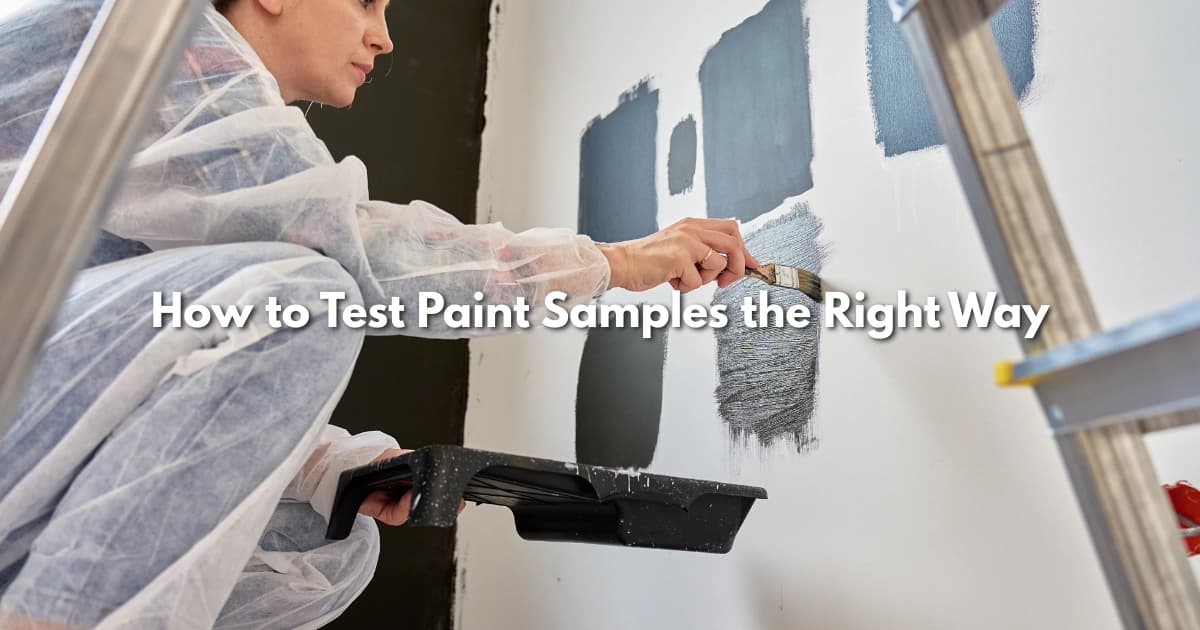
How to Match Paint Colors Across Brands
To match a paint color across brands, look up the color on Paint Color HQ, where every color page displays CIEDE2000-calculated matches from all 14 brands in our 25,000+ color database, ranked by Delta E score. Any match with a Delta E under 2.0 is virtually indistinguishable to the human eye. For example, Benjamin Moore White Dove (OC-17) matches to Sherwin-Williams Pure White (SW 7005) with a Delta E of approximately 2.4, and Farrow & Ball Cornforth White (No. 228) matches to SW Repose Gray within Delta E 2.0. This guide explains the science, the tools, and the step-by-step process for finding accurate cross-brand equivalents.
Why You Need Cross-Brand Paint Matching
Cross-brand matching is essential in four scenarios: (1) a designer specifies Benjamin Moore but your contractor stocks Sherwin-Williams; (2) you move to an area where your brand is unavailable; (3) a Farrow & Ball color at $115/gallon needs a Behr equivalent at $45/gallon or Valspar at $38/gallon; or (4) the original color has been discontinued and you need the closest surviving equivalent.
In all of these cases, you need more than an eyeball guess. You need science-backed color matching — and that's where Delta E comes in.
Why Paint Store Color Matching Falls Short
Paint stores scan a chip with a spectrophotometer and mix a custom color, but the result depends on the device's calibration — and in-store spectrophotometers drift between calibrations, producing Delta E errors of 2.0–5.0 on a single scan. Custom-mixed colors also carry a hidden risk: batch-to-batch variation means a touch-up in two years will not match the original mix. Standard catalog colors are formulated to strict tolerances (typically Delta E under 0.5 batch-to-batch), making them far more reliable.
A better approach is to find the manufacturer's closest existing catalog color, which was specifically formulated and tested for their paint base. That's what Paint Color HQ helps you do — find the best standard color match, not a custom approximation.
Understanding Delta E and CIEDE2000 Color Science
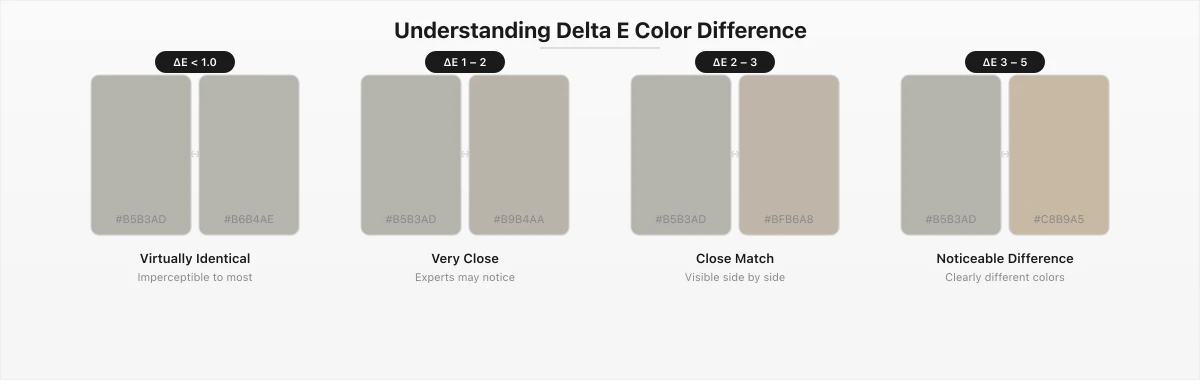
Delta E (ΔE) measures the perceptual difference between two colors. The CIEDE2000 revision of the formula — which Paint Color HQ uses for every match calculation — is the gold standard in color science. Unlike simpler formulas that just compare RGB values, CIEDE2000 accounts for the fact that human eyes are more sensitive to some color differences than others. For example, we're more sensitive to differences in neutral tones (grays, beiges) than in saturated colors, and CIEDE2000 weights its calculations accordingly.
Here's what Delta E scores mean in practice:
ΔE < 1.0 — Virtually identical. Imperceptible to most people, even side by side. This is a near-perfect match.
ΔE 1.0–2.0 — Very close. Only perceptible through close, deliberate observation. Most homeowners would consider this an excellent match.
ΔE 2.0–3.0 — Close but noticeable. Perceptible at a glance. Acceptable for rooms that won't be seen side by side with the original.
ΔE 3.0–5.0 — Noticeably different. Most people would say these are different colors. Proceed with caution.
ΔE > 5.0 — Clearly different colors. Not recommended as a match.
Our database shows that the vast majority of popular colors from major brands have at least one cross-brand match within ΔE 2.0 — meaning you can almost always find an excellent equivalent. Browse our gray and beige color families to see how closely the top neutrals from different brands align.
Step-by-Step: How to Match Paint Colors on Paint Color HQ
Step 1: Identify your original color. Find the exact name, color code, and brand. Check the lid of the paint can, the receipt, or the designer's specification sheet. If you only have a photo or a physical sample, use our color identifier tool — upload an image and we'll identify the closest paint color in our database.
Step 2: Look up the color on Paint Color HQ. Use our color search to find it by name, color code, or hex value. You can also browse by brand — for example, the Sherwin-Williams catalog or Benjamin Moore catalog. Every color page automatically displays the closest matches from all 14 brands in our 25,000+ color database, ranked by Delta E score.
Step 3: Review the Delta E scores. We display the CIEDE2000 ΔE value for every suggested match. Look for matches under 2.0 for a nearly invisible difference. Under 3.0 is acceptable for most residential projects where the original and the match won't be seen in the same room.
Step 4: Compare side by side. Use our color compare tool to place your original color next to its closest match. You'll see the exact ΔE score, RGB values, undertone analysis, and a large visual comparison swatch — far more useful than squinting at tiny paint chips.
Step 5: Visualize it in your room. Before committing, preview the match in context with our room visualizer. Upload a photo of your space and see how the matched color actually looks on your walls, accounting for your room's specific lighting and furnishings.
Step 6: Always sample. Even with a low Delta E score, always paint a physical sample on your wall. Digital screens cannot perfectly represent paint colors, and factors like sheen, texture, and your room's lighting conditions affect the final result. Read our guide to paint color undertones for a deeper explanation of why colors shift in different lighting.
Real Examples: Popular Cross-Brand Matches
Let's walk through some of the most common cross-brand matching scenarios using real colors from our database.
Finding the Behr equivalent of Agreeable Gray. Agreeable Gray(Sherwin-Williams) (LRV 60, hex #D0C8B5) is America's most popular paint color. The closest Behr equivalent is Wheat Bread(Behr) (N300-3) — a warm greige with a CIEDE2000 Delta E of approximately 1.8, meaning the two colors are virtually indistinguishable on a wall.
Matching Edgecomb Gray across brands. Edgecomb Gray(Benjamin Moore) (HC-173, LRV 63) is a designer favorite warm greige. Its closest Sherwin-Williams match is Agreeable Gray(Sherwin-Williams) (SW 7029, LRV 60) with a Delta E of approximately 2.4 — close but perceptible side by side. Head to the Edgecomb Gray page to see all cross-brand matches ranked by Delta E.
Budget-friendly alternative to Farrow & Ball. Love Cornforth White(Farrow & Ball) (No. 228, $115/gallon) but not the price? Its closest Sherwin-Williams match falls within Delta E 2.0 at $50–60/gallon during SW sales — saving $55+ per gallon with a perceptually identical result. Check the Cornforth White page for all cross-brand matches ranked by CIEDE2000 Delta E.
Matching a classic white. White Dove(Benjamin Moore) is the most popular warm white in the country. The Sherwin-Williams equivalent is often Pure White(Sherwin-Williams), though the undertones are slightly different — White Dove leans a touch more yellow while Pure White is a bit creamier. Use the compare tool to see the exact difference. For more on choosing whites, read our best white paint colors guide.
Navy blues across brands. Hale Navy(Benjamin Moore) is a classic navy that designers love for accent walls and cabinetry. If you need a Sherwin-Williams alternative, search for Hale Navy on our site and you'll find the closest SW navy ranked by Delta E. Explore more options in the blue color family.
When a Perfect Match Doesn't Exist
About 15% of cross-brand searches return a closest match with a Delta E above 3.0 — most commonly with highly saturated greens, deep reds, and unusual accent colors. Popular neutrals (grays, beiges, whites) almost always have a match under Delta E 2.0. When no close match exists, you have three options.
First, ask the paint store to custom-match using the original brand's color chip. This gives you the closest possible match in your preferred brand's paint base. Second, explore adjacent colors on Paint Color HQ — sometimes a slightly different shade actually works even better for your space. Use our palette generator to see how related colors work together in a full room scheme. Third, test the “imperfect” match on your wall — a color with Delta E 3.0–4.0 from your original often looks better in your specific room because of how your lighting, flooring, and furnishings interact with the undertone.
Common Mistakes When Matching Paint Colors
Matching by name alone. Color names are marketing, not science. “Agreeable Gray” and “Repose Gray” are both Sherwin-Williams grays, but they look noticeably different. Always match by Delta E, not by name. Use our color search to find exact matches based on the actual color values.
Ignoring undertones. Two colors can look similar on a screen but have completely different undertones — one might lean pink while the other leans green. This becomes obvious on a large wall. Our color pages show undertone analysis for every color, and our undertones guide explains why this matters.
Skipping the physical sample. No matter how low the Delta E score, always buy a sample pot and paint a 12-by-12-inch swatch on your actual wall. View it at different times of day — morning light, afternoon light, and artificial light at night. Colors shift dramatically based on lighting conditions. Read our guide to testing paint samples for the full process.
Forgetting about sheen. The same color in flat, eggshell, satin, and semi-gloss finishes will look different. Higher sheens reflect more light and tend to make colors look slightly lighter and more saturated. When comparing a match from another brand, make sure you're comparing the same sheen level.
Matching from a photo. Phone cameras and monitors distort color. If you're starting from a photo, use our color identifier as a starting point, but treat the result as a suggestion, not gospel. Confirm with a physical chip whenever possible.
Tips for Verifying Your Match with Physical Samples
Once you've identified a cross-brand match on Paint Color HQ, here's how to verify it in the real world. Buy sample pots of both your original color and the proposed match. Paint two large swatches (at least 12 by 12 inches) on the same wall, side by side. View them at four different times: early morning, midday with direct sun, late afternoon, and nighttime under your artificial lights. Pay attention to how the undertones shift — a color that looks identical at noon might diverge at sunset.
If you're matching across rooms (not placing the colors side by side), you have more flexibility. A ΔE of 2.0–3.0 is usually acceptable when the colors will be in separate spaces. Use the room visualizer to preview the matched color in context before buying samples.
Start Matching Colors Now
Cross-brand paint color matching is a solved problem. Paint Color HQ's 25,000+ color database spans 14 brands — Sherwin-Williams, Benjamin Moore, Behr, Valspar, PPG, Dunn-Edwards, and Farrow & Ball among them — and uses the CIEDE2000 formula (the same perceptual color-difference standard used by the International Commission on Illumination) to calculate every match. Start by searching for your color in our color search, or use the compare tool to evaluate any two colors side by side. If you're starting from a photo, try the color identifier — and use the paint calculator to figure out how much paint you'll need once you've found your match.